


"there’s so much in front of us, so much beyond us": Interview with Sarah Yanni

Sarah Yanni’s “August” is a meditation on care, nature, and the passage of time. She wrote her first draft, as she does everything she writes, in her notebook. An experimentation with form, which follows the scanned journal page below, brought her out of free verse. But she didn’t stay in couplets, finding her own rhythm the way Californians find a new way to mark the passage of time. I had an email interview with Yanni to discuss her editorial process with this poem.
Brittany Torres Rivera (BTR): In the second draft, we see a direct address to the reader replace two observations from the first draft (“gestures of care / can be so hard / to come by, but look! / spring’s consistent re-birth!”). From where did this new, exclamatory voice arise? Is there something about the subject matter that brings this out?
Sarah Yanni (SY): It’s been over two years since I wrote the first draft of this poem, so I’m trying to recall my intentions and impulses to the best of my abilities. I believe that this change came from my desire to materialize the feeling of awe and sacredness that encountering the natural world created for me. I wanted to almost shake the reader out of the haze of continuous dailiness, and be like, “no, actually, look at this!” I live in Los Angeles, and it’s easy to get stuck in the rote movements of the big city, but the fact is, we are surrounded by so much ecology and cyclicality; there’s so much in front of us, so much beyond us.
BTR: In your notes to me, you wrote that you “really wanted to make it work with couplets” in that second draft. What bore this desire to formalize the poem?
SY: As a poet, I’ve always loved couplets. I’ve had peers joke that it’s not a Sarah Yanni poem if it’s not in couplets. It’s interesting, I’ve never truly interrogated my penchant for that form, or for pushing works into it, but I think it’s something to do with movement, patterns, quickness—it immediately gives the work a sense of tension, and can be seen as a breeding ground for dichotomies or unlikely pairings. I’m also a Gemini, a sign that’s all about twins, duality, a front side and a reverse side, so, if I can get esoteric for a moment, perhaps it’s that sensibility coming through on the page. But there are times it isn’t the right home for the words. I can concede. In this case, I did.
BTR: The shift away from couplets leaves us with more complete narrative blocks within each stanza, eliminating some of the suspension or ambiguity of the second draft (“When I lost my voice for five days / I only listened // to the birds” versus “When I lost my voice for five days / I only listened to the birds”). Do you tend to prioritize narrative clarity as you revise? Does it depend on the poem?
SY: I am often thinking about narrative clarity when editing, but also––put more simply––I think about concision and pacing. I don’t subscribe to the school of thinking that a poem is better the more direct and barren it is (I love a run-on metaphor, or some exploratory movement through language), but I think about, in editing, how lineation can be a way to create both clarity and emphasis. Of bringing the reader more fully into a place of understanding exactly the emotion or image you’re attempting to conjure. I think that drive––more so than pure narrative clarity––is what I think about when I’m in revision.
BTR: The draft from your journal is quite focused in scope: you, another caregiver figure, and the birds. But the final poem opens up to include the setting: spring and the seasons and the city. And at the same time we lose some of the internal dialogue about pleasure, selfishness, and a desire for life. Do you see these two changes as complementary? Does expanding into the world mean limiting interiority to you?
SY: This is an eternal question I have as a poet––how to navigate interiority versus exteriority. And I think in an ideal poem, of course, you have both. I’ve written works where I’m recounting with deep detail a specific experience that I know in my own head, but there isn’t an entry point for the reader, or even a metaphorical hand extending outwards, providing some relief from the lack of relationality. (I also don’t believe you have to spoon-feed a clear translation to the reader.) On the other hand, I’ve written poems that just feel like observations about nature, but there isn’t a central grounding drive or human element that is giving context or meaning—it feels like field notes or diary entries. I don’t have a clear-cut answer, because I think this is a central concern of mine as a writer, and something that I’ve continued to struggle with, especially as the topics feel more and more disparate––i.e. the “exterior” thing I’m writing about is genocide, and the “interior” is my love life. How to fit that into a single writing life? Or even a single project? I’m still figuring it out.
BTR: “Tomorrow, and tomorrow” calls to mind Macbeth’s speech about the fleeting nature of life, a concept that you seem to hint at in your first draft with “What a fever: I can’t stop living.” Was it a conscious choice to let Shakespeare speak for the speaker of the poem in this respect? What is the role of literary allusion in your work?
SY: “What a fever: I can’t stop living” is (I’m pretty sure) a Clarice Lispector line. She has such a fantastic way of playing with words and especially declarative statements––I have lines of hers etched into the corners of my notebooks and my poems. It was actually not a conscious decision to include the Shakespeare allegory. I remember listening to an episode of Katie Dalebout’s podcast Let It Out, in which she has longform conversations with “creatives.” Dalebout was talking to someone who lived in Los Angeles (where I’ve lived my whole life) about seasonality, how the lack of clear seasonal distinctions also gives us, as residents, the opportunity to mark time in new ways, or to blur the boundaries of strict cycles. I remember that really stuck with me. I’m sorry for complaining about our eternal Californian sun, but I do sometimes get a feeling of stuck-ness or exhaustion at the continuous heat, and I romanticize places where leaves change in more drastic ways, and the snow falls as the days get shorter and cozier. So I think when I was writing this line, about how spring is “yesterday, now, tomorrow and tomorrow,” it was also about storytelling and agency, about the sense of wonder I was attempting to evoke in the earlier stanzas, and how that can coexist with a sense of limitation, and it often does. And so, what can we invent from that place?

Sarah Yanni's writing can be found in Mizna, Apogee, wildness, Pleiades, and the Los Angeles Review of Books, among others. Her chapbook, Hard Crush, was released by Wonder Press in 2024.
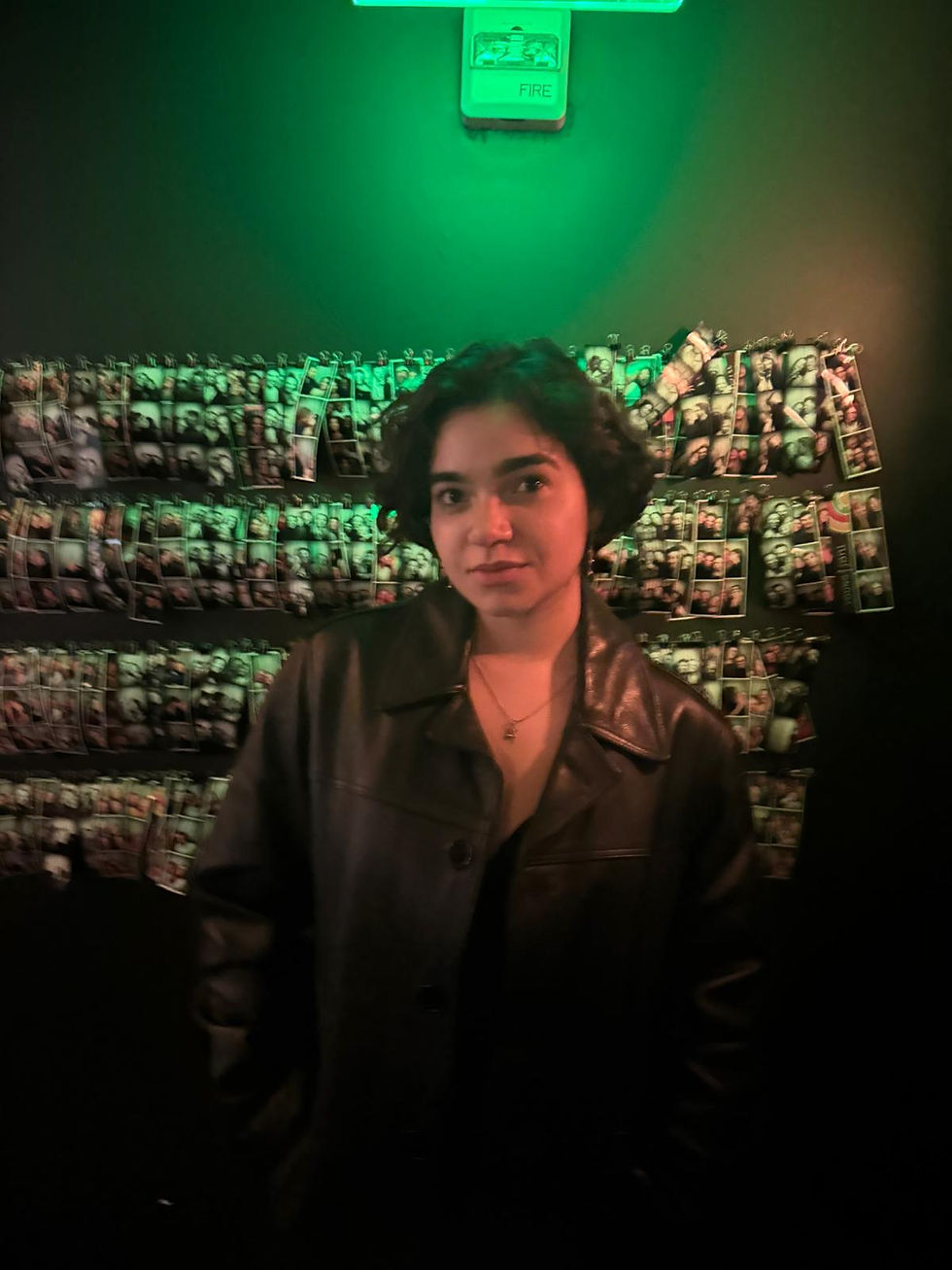
Brittany Torres Rivera is a bilingual editor and writer. An alumna of the Fulbright Program, she is a contributing editor for Letras Latinas Blog 2. Born in Puerto Rico and raised in Florida, she is based in Minneapolis, Minnesota, where she is the assistant editor at Graywolf Press. At Graywolf, Torres Rivera works on poetry, fiction, and nonfiction titles, and is especially involved in works in translation from the Spanish.


