


"what if this is me dressing myself for this demise?": Interview with Irene Vázquez

Irene Vázquez's poem “When I Die” is a scathing yet subtle criticism of the way disaster relief is intertwined with immigration enforcement in the US. Vázquez refines the first draft (below) to narrow the focus, intensify the images, and immortalize a persona. I spoke with them over Zoom to discuss the artistic influences and editorial decisions that transformed the piece.
If I die, it will be murder, it will be
The state, and so, lace my doc martens
One last time.
Hem my dress with the levees of broken
Promises, let the skirt shimmer
Brown and Delta blue let the neckline
Sink deeper as the coast erodes
I intend to bring FEMA and why not,
The whole department of homeland security down
With me,
And I will look sickening, crown
My braids with a halo of shucked oysters,
Forget not the oyster knife,
Curl my fingers around it before
Rigor mortis sets in
I will leave a trail of floodwater
Behind me
They will know where to find
Me they will know
I am coming
Brittany Torres Rivera (BTR): Between the first and final drafts, we lose the explicit naming of the organizations against which the poem is a rallying cry: “I intend to bring FEMA and why not, / the whole department of homeland security down / with me” is replaced by an unnamed “you.” Was this a shift in purpose for the poem, or just a shift toward subtlety? And how did changing the speaker’s audience change the poem for you?
Irene Vázquez (IV): I definitely still see it as a poem that’s directed towards FEMA. I grew up in New Orleans. I was there until Katrina, and then my family moved to Houston. And so a lot of my work is shaped by dealing with various forms of governmental neglect. I was trying to draw attention to the fact that FEMA is housed within the Department of Homeland Security and make it about how it’s strange that there are these securitizing forces and pernicious national security forces inherently involved in disaster relief. I decided to zoom in the focus a little bit more. In the final draft, there’s a reference: “slapping my brother on the back / and saying heck of a job.” That’s an exchange between George Bush and the administrator of FEMA at the time, Michael Brown, where Bush claps him on the back and says, “Heck of a job, Brownie,” while there’s this horrible situation unfolding in New Orleans. Ultimately, it fell outside of the scope of this particular poem. I still have that implicit confrontation with the forces that are threatening the possibility of life on the Gulf, but I just shrunk it a little bit.
BTR: You talk about shrinking the focus, but interestingly, your revision makes the poem longer, featuring details and images that become darker and more intense. For example, “floodwater” becomes “sewage” and “coming” becoming an intention “to die.” Are you often turning up the heat as you revise? Does it depend on the themes of the poem? What made that the right approach for “When I Die”?
IR: I wrote and revised the poem around the time the show Lovecraft Country was on HBO. It had all this monstrous imagery as a commentary on systemic racism and Jim Crow. And there was a great song on the soundtrack that I kept revisiting: Alice Smith’s cover of Nina Simone’s “I Put a Spell on You.” Oftentimes when I’m revising, if I land on a song or something that really helps me sink into the modality that I’m going to try to achieve in the poem, I’ll listen to it on repeat so that I’m not necessarily thinking about the song itself, but it moves into the backdrop. I think that’s what ended up happening here; I really liked this macabre corpse bride imagery, and the song really helped me dial into the feeling and the imagery of that.
BTR: In a short interview about this poem’s genesis, you mention that the corpse bride character became a central image in the poem after a prompt about clothing bore the first draft. How do different forms of media inform or appear in your writing? Are there other hidden allusions to other pieces of art in the final draft?
IV: Yes, absolutely. I consider myself very referential. I am interested in making deliberate references that, when I perform a poem for different groups of people, different people will pick up on different references. I’m someone that really loves to borrow. I think of it almost as sampling from the musical tradition. There’s a Mary Oliver reference in the poem: “I was once a bride / married to amazement.” I took this idea, the way that the sample takes a piece of existing music and remixes it or interpolates it or speeds it up or slows it down to have this new context in a new song. That’s what I was trying to do with that bride imagery. And it really unlocked something for me, being able to take that image from the poet that got me into writing poetry, someone who writes so beautifully about the environment in this tender, intimate way, and then show how the pernicious forces on the Gulf and the colonial forces, all these extractive forces, pervert that beautiful image into something much darker.
BTR: In the final draft, the speaker’s death (after a sort of resurrection) is an active choice, while the first draft makes it clear that the death would be a murder by the state. What catalyzed such a big shift in the narrative and the speaker’s agency?
IV: That’s a great question. When I initially drafted the poem, it was very intentionally thinking about these histories of activists being targeted for the work they’re doing, as well as the way that Black and Brown communities have historically been subjected to state neglect as a form of murder. I was thinking about it almost like a directive addressed to a loved one. There’s this great Jericho Brown poem in his most recent collection where he says, if he were to die in police custody, know that was never a choice he would have made. I’m thinking about, in our present era of increased ICE detention and people dying in ICE custody, the circumstances under which people die at the hands of the state.
I think the shifting of the agency happened as a result of the address of the poem changing. When I first wrote it, it was, Hello, beloved, if I die, you know the kind of people I was trying to target with my work, remember me and what I was trying to do and understand that this was not my choice. As I began to develop the poem in Shira Ehrlichman’s surreal life workshop, one of my workshop partners asked me, Where is this poem taking place? Where are you while putting this on? Where are you going while wearing it? What catwalk will you strut down to get there? So the word catwalk then appears. And I was like, what if instead of I happen to be wearing this when I am targeted, what if this is me dressing myself for this demise? It sank into this Afro-pessimistic form of This is a choice that I make, knowing what I know about the era that we live in. I will dress myself accordingly. And I will make the choice to die in the service of the place that I love.
BTR: Is there anything that we didn’t get a chance to talk about today or that hasn’t come up that really excites you about the editorial process that you went through with this poem or that you want to point out to readers?
IV: Obviously, it’s a persona poem of this corpse bride of the Gulf, if you will. But thinking about the ways that my gender presentation has also changed since I initially wrote this—I had identified as non-binary since before I wrote this poem, but at the time I had a high femme, red lipstick, winged eyeliner kind of presentation that I was drawing from when I was creating this character that I no longer really access as much anymore. So it’s fun to see it also memorialized in this moment in time.

Born in New Orleans, raised in Houston, & now living in Manhattan, Irene Vázquez is a queer Black Mexican American poet, translator, and journalist. Irene's debut chapbook Take Me to the Water was released by Bloof Books. Their writing also appears in When Language Broke Open: An Anthology of Queer and Trans Black Writers of Latin American Descent (The University of Arizona Press) and Attached to the Living World: A New Ecopoetry Anthology (Trinity University Press). They are a Best of the Net- and Pushcart Prize-nominated writer, whose work can be found in Muzzle andOxford American, among others. By day, Irene works as a children’s book scout at Maria B. Campbell Associates.
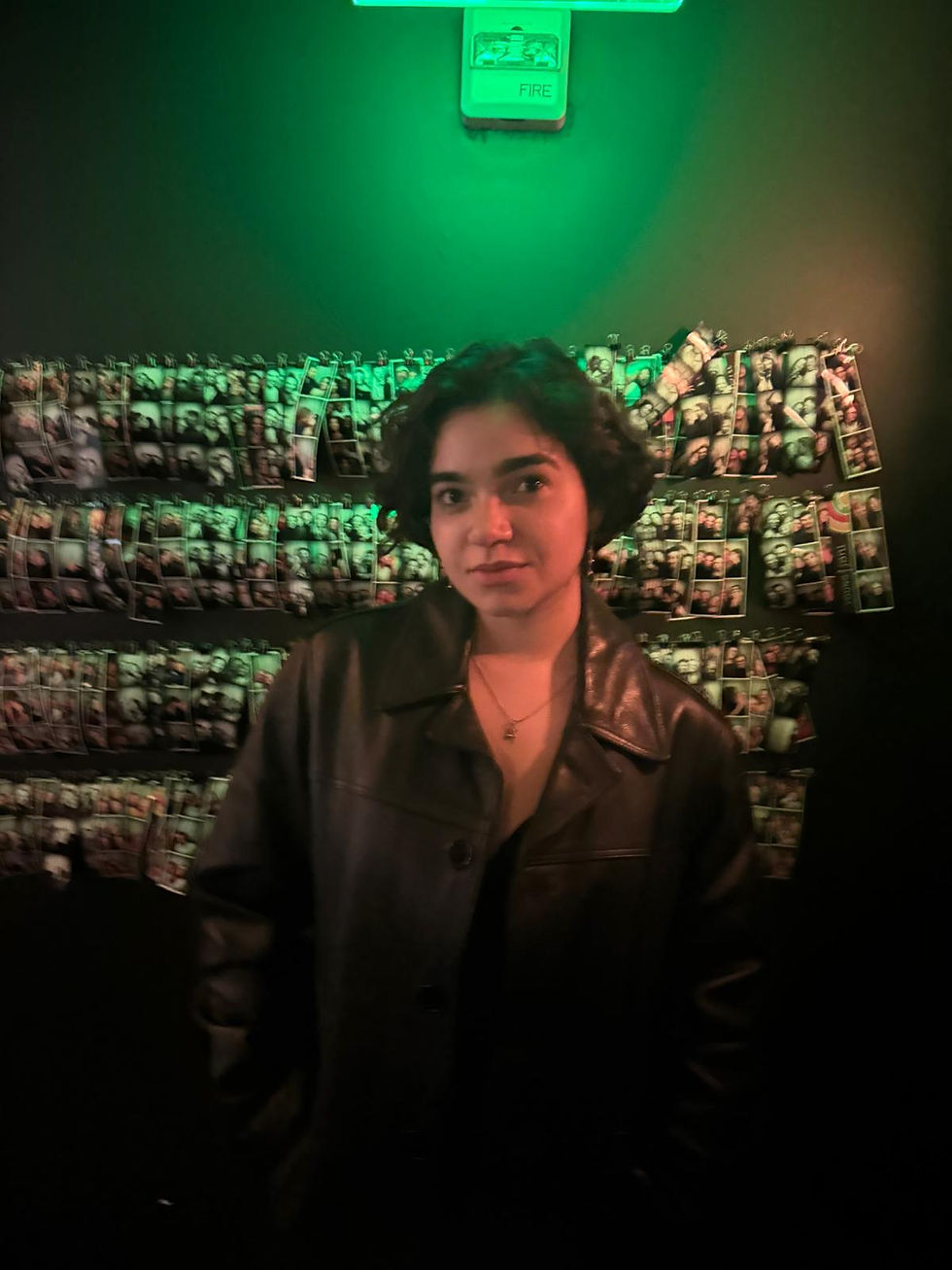
Brittany Torres Rivera is a bilingual editor and writer. An alumna of the Fulbright Program, she is a contributing editor for Letras Latinas Blog 2. Born in Puerto Rico and raised in Florida, she is based in Minneapolis, Minnesota, where she is the assistant editor at Graywolf Press. At Graywolf, Torres Rivera works on poetry, fiction, and nonfiction titles, and is especially involved in works in translation from the Spanish.


