


"I like to think of this poem as a page found in the middle of a forest." Interview with Edward Sambrano III

As an undergrad, Edward Sambrano III took a poetry workshop with poet and critic James Longenbach. Sambrano wrote the first and final draft of “How to Make Friends: (Excerpt from a Self-Help Book)” in the spring of 2018, and the poem was published two years later. Now, eight years after its initial drafting, I had an email interview with Sambrano to talk about his revision process for the poem, and how it compares to his approach today.

Brittany Torres Rivera (BTR): Is there a prompt that inspired this poem? If so, what was it?
Edward Sambrano III (ES): Because Jim didn’t assign us prompts—each poem we submitted was entirely of our own design—no influence, outside of, say, my own youthful angst, really inspired the poem. I think, if I were to try to put words to what might have been its inspiration (it was so long ago!), I’d say I wanted to allegorize the impacts of an upbringing on the future social successes (or lack thereof!) of my speaker.
BTR: Do you use prompts today? If not, how do you usually start a draft?
ES: I don’t use prompts when I write, not in any strict sense. I’ve taken many workshops in which there are rigorous and lengthy prompts, and when I teach poetry workshops, I often craft and assign my own equally frustrating ones. Something I try to stress to my students is that whatever’s going on in your own head when beginning and revising a poem is as arbitrary as a prompt of someone else’s design. Form is form, whether from within or without. Certain words, utterances, scenarios, and ideas call to me for one reason or another; they accumulate in my phone’s notes app, they become pseudo-philosophical ramblings in a Word doc, then the real work begins!
BTR: Besides Jim Longenbach, were there others involved in your revision process?
ES: The poem was workshopped by my peers, which I of course appreciated, and which probably informed the final draft. But what I really remember most is Jim’s feedback; I frequented his office hours often and learned so much from him. It felt really special, his careful attention to my work. He was an incredibly generous teacher.
BTR: Do you still involve other writers/readers in your revision?
ES: Maybe because of the mentorship model I learned to value so much during my time working with Jim, I’ve always felt kind of immune to peer feedback, for better or worse. It takes a sort of intellectual and emotional proximity, which I suspect can be established only spatially and temporally, to provide truly, profoundly meaningful feedback. This is, as you may know, so hard to come by. My dear friend, former roommate, and cohort member of my MFA program, the poet and critic Will Carpenter, showed me that this type of relationship doesn’t need to be between professor and student, that our friends are our constant mentors, in life as in writing. He gets first dibs on any draft I write. When life provides the chance, we hop on Facetime and talk through one another’s poems.
BTR: It seems you responded to Jim’s “a little murky” note by expanding a single line into two new stanzas. In these, suggestions of a dark home life (present in the images of burning pages and scarred skin from the original draft) are made more explicit. What were your goals with that edit, and how did you land on expansion as your solution?
ES: Wow. That’s interesting, and such a keen observation. Perhaps I’ll answer that by imperfectly parroting wisdom from Jim: The only difference between good and bad writing is specificity. And keep the machine in the air! If I was writing murkily, I wasn’t being specific enough. One solution I find myself returning to is to write out my thought process as thoroughly as possible, which helps iron out the vaguenesses. Often, this doesn’t produce anything particularly compelling (see the pseudo-philosophical ramblings I mentioned above), but to be productively mysterious—that’s the job of revision. I’d like to think this part of the poem still holds up. At any rate, at that time in my writing life, brevity was my ideal, and Jim helped disabuse me of that impulse. Writing a short poem is hard, as is writing a long poem. Better to write a lot of ineffective material and cut down, or revise, if necessary. In summary, my goal was to be true to the poem, and that required a specificity I hadn’t yet earned.
BTR: How do you balance narrative clarity and subtlety in your work today?
ES: More imperfect parroting: What’s subtle is mysterious, and depends on clarity, which is the opposite of confusion. If I am clear at the level of the utterance, I can trust the poem to be as subtle as it wants to be.
BTR: Jim pointed out the ambiguity of “they’re” in the first draft, but you decided to leave it in the final. Why not clarify? As a student, how did you decide which notes to implement and which to not?
ES: I like to think of this poem as a page found in the middle of a forest. Someone tore it out of the self-help book to which it belongs and you, the reader, stumble across it and are left to wonder at the surrounding circumstances. Why is the speaker so tortured, and in a text in which they serve as the authoritative writer? The friend mentioned in the poem could be anyone, or everyone, hypothetical or real. I still enjoy using the third-person singular “they” to indicate anonymity, though its use seems at its surface to violate the principle I mentioned in my last answer. There are different ways to be true to something. I’m no longer a student in any traditional sense, but when I was, I took most of the feedback provided me by professors, besides maybe minor line edits like this one. Now I have the benefit of being able to chat at length about drafts with my first reader, Will, and to weigh his arguments against how much effort I’m willing to exert for any given poem. (Paul Valéry’s proposition, paraphrased by W. H. Auden as “A poem is never finished, only abandoned,” is a nice excuse to move on whenever one wants, at least for the lazy poet.)
BTR: Do you have any advice for students about how to make the most of their poetry workshops?
ES: Don’t be precious about your writing. It’s all just words on a page. A more inane version of this is implied by the phrase “kill your darlings.” Counterintuitively, accepting the mundanity of whatever it is you have to say will free you up to make truly gorgeous poems.

Edward Sambrano III is a Latinx poet, critic, editor, and educator from San Antonio, Texas. They received their MFA from the University of Florida, and support from the Bread Loaf Writers’ Conference, Community of Writers, and Virginia Center for the Creative Arts. A poetry editor for The Dodge, they have writing in The American Poetry Review, The Georgia Review, Ploughshares, Pleiades, and other journals. Their debut full-length poetry manuscript was named a semifinalist for Tupelo Press’s 2025 Helena Whitehill Award, and their debut chapbook manuscript was named a finalist in the 2025 Gold Line Press and 2025 Sixth Finch chapbook contests. They teach at the University of Michigan.
Author photo credit: Nicholas Nichols
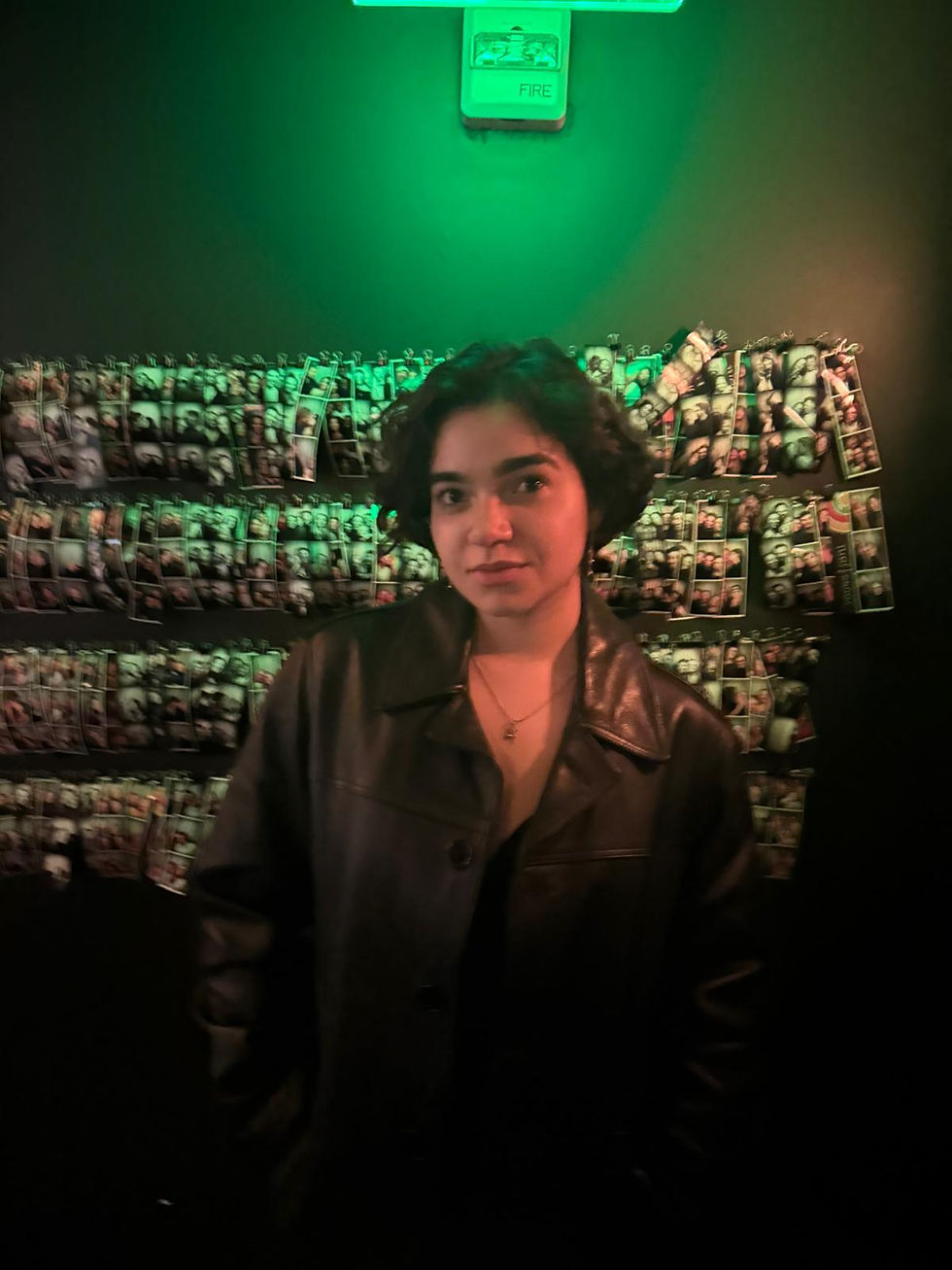
Brittany Torres Rivera is a bilingual editor and writer. An alumna of the Fulbright Program, she is a contributing editor for Letras Latinas Blog 2. Born in Puerto Rico and raised in Florida, she is based in Minneapolis, Minnesota, where she is the assistant editor at Graywolf Press. At Graywolf, Torres Rivera works on poetry, fiction, and nonfiction titles, and is especially involved in works in translation from the Spanish.


